
The Inner Critic: How to Turn Self-Doubt Into Self-Discipline
Mind Over Matter: The Psychology of Growth
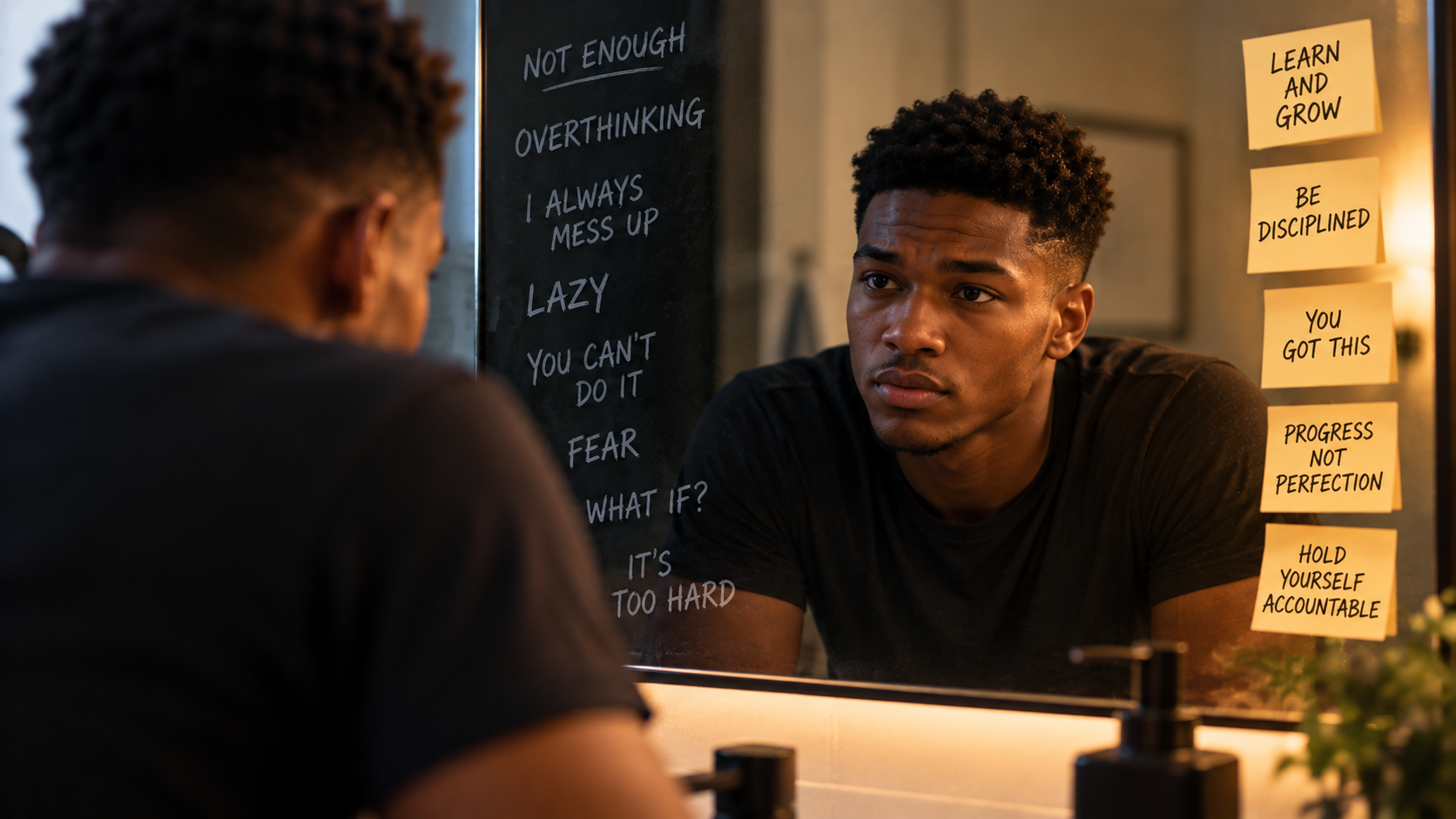
There are moments when the hardest person to face isn't someone standing in front of you. It's the person staring back at you in the mirror.
Maybe you said something you regret. Maybe you promised yourself you'd do better and fell into the same habits again. Maybe you watched someone your age accomplish something you've been struggling to achieve, and suddenly every decision you've made feels like evidence that you're falling behind.
Then the voice starts.
You're not good enough. You always mess things up. What's the point of trying if you're just going to fail again?
What's troubling about that voice is how familiar it can become. After hearing it enough times, you stop questioning whether it's telling the truth. You begin treating its criticism like a description of who you are.
But there is a difference between recognizing that you need to change and believing that you are incapable of changing. One creates an opportunity for growth. The other can convince you there's no reason to try.
Understanding that difference is where self-discipline begins.
When Your Own Mind Becomes Your Biggest Opponent
Every person develops an internal dialogue. It's the running conversation we have with ourselves about our choices, abilities, failures, and expectations. Sometimes it helps us work through problems, prepare for challenges, and recognize where we need to improve. Other times, it becomes a relentless source of judgment.
For young men, that judgment can be especially difficult to recognize. There can be pressure to appear confident, remain in control, and act as though nothing gets under your skin. Admitting uncertainty might feel like exposing a weakness, especially when you've grown accustomed to being told to toughen up or figure things out on your own.
So instead of discussing those feelings, you carry them quietly. You might criticize yourself for not being further ahead, compare your progress to someone else's, or replay mistakes that everyone around you has already forgotten.
Eventually, the expectation to become better can turn into the belief that nothing you do will ever be enough.
The problem isn't necessarily that you have high standards. Wanting more from yourself can be healthy. The problem develops when those standards become impossible to satisfy and every setback becomes another reason to question your worth.
A missed opportunity isn't proof that you're incapable. A poor decision doesn't erase every good decision you've made. And struggling to change a habit doesn't mean you're destined to repeat it forever.
Your mistakes deserve your attention. They do not deserve control over your identity.
The Difference Between Discipline and Self-Punishment
Somewhere along the way, many of us learn to associate discipline with being hard on ourselves.
We believe that if we criticize ourselves enough, we'll eventually become motivated to change. We treat disappointment like fuel and assume that being gentle with ourselves means we're making excuses.
But consider the difference between two responses to the same mistake.
One says, You failed again because you're lazy. You never finish anything.
The other says, You didn't follow through. What got in the way, and what are you going to do differently tomorrow?
Both recognize that something went wrong. Only one gives you a useful direction forward.
Psychological research supports this distinction. In a series of four experiments, researchers Juliana Breines and Serena Chen found that responding to personal shortcomings with self-compassion could increase motivation for improvement. In one experiment, participants encouraged to respond compassionately to an initial failure spent more time studying for another test than participants in the comparison conditions.
Their findings challenge the assumption that people need to tear themselves down to become better.
Read the research: Self-Compassion Increases Self-Improvement Motivation (2012)
Being compassionate toward yourself doesn't mean ignoring the consequences of your actions. It means recognizing that accountability and self-respect can exist together.
You can acknowledge that you made a poor decision without deciding that you are a poor person. You can recognize that you've fallen short without believing you'll always stay there.
Real discipline isn't built by convincing yourself that you're worthless until you succeed. It's built by developing the willingness to keep showing up, even when your progress isn't perfect.
Turning the Inner Critic Into an Inner Coach
Imagine having a coach who responded to every missed shot, failed assignment, or difficult practice by telling you that you were hopeless.
Would that help you improve? Or would it eventually make you afraid to try?
Now imagine a coach who refused to ignore your mistakes but also refused to define you by them. Someone who expected accountability, helped you identify what went wrong, and reminded you that improvement requires repetition, patience, and effort.
That's the kind of relationship you need to develop with yourself.
It begins by noticing the way you speak to yourself when things aren't going well. When you catch yourself thinking, I'm terrible at everything, stop and ask whether that's an accurate observation or an emotional reaction. Usually, a single disappointment doesn't justify such a sweeping conclusion.
Instead of accepting the criticism automatically, examine it.
Maybe you didn't prepare for something important. Maybe you allowed fear to keep you from taking an opportunity. Maybe you reacted out of frustration and hurt someone you care about.
Those situations deserve honesty. But honesty should lead to action rather than endless punishment.
You might replace I never do anything right with I need to prepare earlier next time. Instead of I'm not strong enough to change, you might tell yourself, This habit has been difficult to break, but I can make one better decision today.
The goal isn't to manufacture confidence you don't feel. It's to build a more accurate conversation with yourself, one that identifies the problem without destroying your belief that you can do something about it.
Over time, that shift can change how you respond to disappointment. Instead of spending all your energy replaying what went wrong, you begin directing some of that energy toward what comes next.
Progress Doesn't Require Perfection
One of the most damaging expectations we place on ourselves is the belief that growth should happen in a straight line.
We imagine the person we want to become and assume that once we commit to changing, every day should reflect that commitment. We expect discipline without distraction, confidence without insecurity, and progress without setbacks.
Then life happens.
You lose your temper after promising to handle things differently. You miss a workout. You procrastinate on a responsibility. You find yourself falling back into a pattern you thought you'd already overcome.
And suddenly, the inner critic has something new to talk about.
But growth doesn't require you to become someone who never struggles. It requires you to become someone who can recognize a struggle without automatically surrendering to it.
Sometimes discipline looks like waking up early and following through on a difficult goal. Other times, it looks like admitting you were wrong, asking someone for help, or returning to a commitment after falling short.
You don't have to dismiss your mistakes to move forward. You have to learn from them.
Why Mentorship Matters in Changing the Conversation
Sometimes the voice inside our heads is shaped by the messages we've heard from people around us.
When criticism, comparison, or disappointment have been familiar experiences, it can become difficult to recognize the difference between constructive feedback and destructive judgment.
That's one reason mentorship matters.
A mentor doesn't have to pretend that every decision you make is a good one. Real mentorship involves honest conversations, difficult questions, and accountability. But it also provides something that self-doubt often takes away: perspective.
When you're struggling to see beyond your latest mistake, another person can help you recognize the progress you've already made. When your expectations become unrealistic, someone you trust can help you establish goals that challenge you without overwhelming you.
At Manifest Change, we believe meaningful growth begins with honest conversations. Not conversations built around shame or pretending to have everything figured out, but conversations that help young men recognize their choices, understand their potential, and take responsibility for the direction of their lives.
Sometimes the most important thing another person can do is help you hear a different message about yourself until you begin to recognize it as a possibility.
The Challenge: Recognize What You've Already Overcome
This week, take a moment to think about something you've overcome that you rarely give yourself credit for.
It doesn't have to be a major accomplishment. Maybe you walked away from an argument instead of escalating it. Maybe you reached out for help when you would normally have stayed silent. Maybe you started rebuilding a relationship, took responsibility for a mistake, or continued working toward something after experiencing disappointment.
Write it down.
Then ask yourself what that experience reveals about your ability to change.
The same mind that reminds you of everything you've done wrong is capable of recognizing what you've learned, how you've grown, and what you still have the ability to become.
Self-discipline doesn't mean silencing every doubt. It means refusing to let doubt make every decision for you.
Your inner critic doesn't have to be your enemy. With awareness, accountability, and practice, it can become a reminder that you still have room to grow.
And there's nothing wrong with being a work in progress.
Where pain becomes power. Where power becomes purpose.
Manifest Change
What's one thing you've overcome that you're proud of? Take a moment to acknowledge it, or share it with someone who has supported your growth.
Keep Moving Forward.
If you or a young man you know is ready for structured 12-week mentorship, accountability, and life direction, start the conversation today.



Comments
Join the Conversation
Share your thoughts on this article.